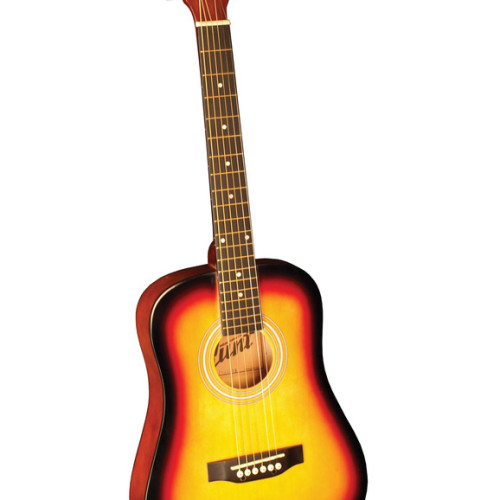
Indiana Runt
This guitar is my first acoustic, and while it isn't perfect, it is quite a nice piece of starter equipment. Let's start with some flaws; the fret wires on this guitar curve off towards the body on the lower side of the neck, and some had a bit of rust when I got mine (shipped via amazon). This really doesn't effect the playing of this guitar and is an aesthetic issue. The other big problem this guitar has is fret buzz, and it has a lot of it, especially towards the lower end of the neck. However, I imagine this issue could be solved with a setup adjustment, something that is a bit beyond my skill set, but won't be expensive at a local music shop. For these few minor flaws, this guitar answers with many great things. First, it's inexpensive. second, chords and high notes ring clear and true from this guitar. It stays in tune just fine if you don't knock it about, and isn't at all difficult of being put back in to tune when you do. With its small size comes a lot of portability, and it can be used easily by child and adult alike. For its low price and high portability, this guitar gets a high recommendation from me.
Where to purchase it
Specs and other reviews
Showing posts with label guitar. Show all posts
Friday, 8 April 2016
Wednesday, 23 March 2016
Boss OS-2 Overdrive/Distortion
Prior to obtaining this pedal I had been using the channel overdrive that came on my amp. Don't get me wrong, this was great for 70's stadium rock and a bit of blues, but just didn't have what I wanted for metal, punk, or grunge. Now, this pedal works by blending overdrive and distortion through a color knob. The knob can go from solely overdrive (all the way to the left) to pure distortion (all the way to the right), and can play wonderfully anywhere in between. The overdrive can still do all that the channel could do and more, and just sounds great. Even on the bridge pickup it sounds rich and full, which was a big problem with my channel overdrive. This pedal's overdrive can do crunch blues rhythm and singing solos in the same breath. Twist the color knob so that it lays somewhere in the middle, and the tone dirties up a bit, perfect for grunge and punk. It sounds great playing Anarchy in the U.K. and Smells Like Teen Spirit without changing a single setting. Turn the knob past 4 o'clock and one of the most beautiful, fuzzy, metal-perfect distortions I have ever heard comes flowing from the amp. Heavily saturated and packed with fuzz, it is perfect for dark metal rhythm. This setting does, however, lack a bit of luster in the higher ranges. But my favorite so far is yet to come. Turn the color knob all the way to distortion and feed it through the overdrive channel, and the most beautiful tone I have in my arsenal comes shining through. play fast and low, and every note comes with a punch, never muddying or losing definition. Play nice and high, and melodies come pouring through your speakers like honey, thick and beautiful. This pedal is, so far, my favorite piece of gear. with its versatility and few flaws, it is a must-have for experts and starting guitarist alike.
Boss website http://www.bossus.com/products/os-2/features/
Other reviews http://www.sweetwater.com/store/detail/OS2/reviews
Boss website http://www.bossus.com/products/os-2/features/
Other reviews http://www.sweetwater.com/store/detail/OS2/reviews
Tuesday, 16 February 2016
Slide Guitar
I love to play slide guitar. Love it. From the great twang and sadness in country style acoustic slide to the thick distortion and menacing movement of rock and roll, I love it all. But it took me a long time to decide on what slide I liked the best. After all, there are a lot of options. Metal, glass, or even stone or ceramic? Dunlop or D'Addario? Thick wall or thin? Days of comparison and research go in to selecting that first slide. And just recently did I find my favorite.
I had been using a Dunlop 215 glass slide until I lost it recently. Having no desire to go out and by a new one, I decide to make my own. So I grabbed an empty bottle and a grind stone drill bit and went to work. scoring around the base of the neck, I then broke the bottle off at the point of the score. It was a bit sharp, so I used the grind stone to dull the edges and the scratch up the surface for a bit of character.
After a bit of practice getting used to the unfamiliar shape and sound, I fell in love. I played that day for hours. I recommend nothing more to the starting slide player than to make your own slide, and here's why; slide guitar sounds incredible when played on crappy things. The best thing you can do to make your slide sound better is to worsen your equipment and a very easy way to do that is to break a bottle and use part of it.
This phenomenon of bad guitars playing great slide is not unobserved. Take a look at Jack White. Jack White's main slide guitar is an electric Kay hollow body arch top made some time in the 1950's. Not even Jack knows when, because he got it from a pawn shop for free when he helped the owner move his fridge as young man (1). This guitar was given to him because it did not look good enough to sell in the pawn shop. Have you ever seen the miserable hunks of wood a pawn shop will try to sell as a guitar? And this one didn't make the cut. The feedback issues on this guitar were so bad that Jack covered the entire front of the body of the guitar, aside from the pickup, in thick construction paper to try to stop it. Now stop reading this and go listen to Seven Nation Army by The White Stripes. Go on. I'll wait.
fantastic right? That sixty year old beat up thing is what is being played on that track, with a metal slide. It sounds so good because of the poor quality of the instrument. And that same philosophy can be applied to your slide itself, and I for one believe it should.
How to make a bottle neck slide
I had been using a Dunlop 215 glass slide until I lost it recently. Having no desire to go out and by a new one, I decide to make my own. So I grabbed an empty bottle and a grind stone drill bit and went to work. scoring around the base of the neck, I then broke the bottle off at the point of the score. It was a bit sharp, so I used the grind stone to dull the edges and the scratch up the surface for a bit of character.
After a bit of practice getting used to the unfamiliar shape and sound, I fell in love. I played that day for hours. I recommend nothing more to the starting slide player than to make your own slide, and here's why; slide guitar sounds incredible when played on crappy things. The best thing you can do to make your slide sound better is to worsen your equipment and a very easy way to do that is to break a bottle and use part of it.
This phenomenon of bad guitars playing great slide is not unobserved. Take a look at Jack White. Jack White's main slide guitar is an electric Kay hollow body arch top made some time in the 1950's. Not even Jack knows when, because he got it from a pawn shop for free when he helped the owner move his fridge as young man (1). This guitar was given to him because it did not look good enough to sell in the pawn shop. Have you ever seen the miserable hunks of wood a pawn shop will try to sell as a guitar? And this one didn't make the cut. The feedback issues on this guitar were so bad that Jack covered the entire front of the body of the guitar, aside from the pickup, in thick construction paper to try to stop it. Now stop reading this and go listen to Seven Nation Army by The White Stripes. Go on. I'll wait.
fantastic right? That sixty year old beat up thing is what is being played on that track, with a metal slide. It sounds so good because of the poor quality of the instrument. And that same philosophy can be applied to your slide itself, and I for one believe it should.
How to make a bottle neck slide
1: It Might Get Loud, Davis Guggenheim, Sony Pictures Classics, 2008
Subscribe to:
Posts (Atom)
